Showing posts with label dance. Show all posts

Saturday, April 27, 2013

Bharata Natyam

BHA- Bhava (Expression), RA- Raga (Music) and TA- Tala (Rhythm)
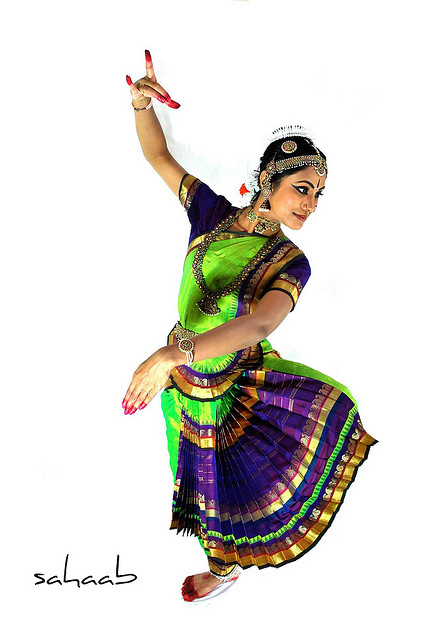


bharata natyam, ( Sanskrit: “Bharata’s dancing”) the principal of the main classical dance styles of India, the others being kuchipudikathakkathakalimanipuri, and odissi. It is indigenous to the Tamil Nadu region and prevalent in southern India. Bharata natyam serves the expression of Hindu religious themes and devotions, and its techniques and terminology have been traced back to ancient treatises such as the Natya-shastra, by the Brahman sage and priest Bharata. Bharata natyam was originally performed exclusively by female temple dancers and was not brought to the stage for public performance until about 1930.

Traditionally the dance was performed by Devadasis (community of temple dancers) in the ancient temples. The Devadasis were women who dedicated their lives to serving the temple deity as dancers and musicians and their performances were an inherent part of the elaborate temple and court rituals.

As we understand Bharatanatyam better, we shall see that the whole body is used to express and reach out to the audience. The gestures using one or two hands are an important part of this expression.

Gestures are not new to us since we use them in our day to day activities also! Just take some time and think of what gesture you would use for following situations:
  • To call a person
  • To point at an object
  • To show drinking
  • Denote a snake
Obviously, we have used some gesture or the other to express the above. So hand gestures are a basic mode of communication. Gesture is a symbolic action by which a thought, a feeling or intention is expressed.
Nritta hastas are a very integral part of any classical Indian dance. These hastas are more or less common for all the classical dances. In Bharatanatyam, hand gestures are used both in Nritta and Nritya.
In Bharatanatyam, hand gestures are divided into two categories:
  1. Asamyukta Hasta – That which is done with one hand or single hand gestures. They are 28 in number.
  2. Samyukta Hasta – That which is done using both hands or double hand gestures. They are 23 in number.

Each hand gestures has many applications or Viniyogas which are described in Sanskrit Slokas of the natayashastra. For eg. Tripataka used in the Nattu Adavu is used to represent a crown, tree, thunder, applying Tilak etc. The interpretation of the gesture is based on the context in which it is used.


Concert Costumes


There are numerous patterns available to choose from today. The most common amongst them are:-
  The Skirt Style costume is usually used by the students practising theVazhuvoor and Kalakshetra style of Bharathanatyam. Its comfortable and easy when a change of costume is involved.
  This is variation of the skirt style with cross pleats- suitable for tall and slim girls.
  The Saree style costumes are suitable for slightly mature girls and women. It gives a sense of maturity and grace while performing padams and javalis.
  The Pyjama style costume is also very common. It is best used with children and slim women in items that requires the dancer to perform male roles or certain kind of poses and routines not condusive to be performed with the skirt or saree style.
  The Blouse for children does not require the thallaippu or pallu and is embellished with a fan.

The Typical Jewellery pieces used by a Bharathanatyam dancer include:-
HeadHead set, Sun and Moon, Rakudi,  etc
EarsEar studs, Jimmiki, Mattal
NoseNose ring, Nose stud and Bullaku ( optional)
HandsBangles,Vanki
WaistBelt or odiyanam
Feetanklet and the bells
HairUsually plaited and fixed with the black and gold kunjalam(South indian parandhi). Samll pendants may be fixed onto the plat.
These jewels are also worn by Kuchipudi dancersand South Indian brides. All the jewels need to be fitted firmly with thread, pins or stitched to ensure they do not move during the recital.
" The costume, jewellery, make-up and stage decoration are aimed at enhancing the beauty, charm and the aesthetic value of the dance performance. Yes, the jewellery worn by a dancer have a special significance: The 'chandran' and 'sooryan' (moon and sun) worn on the top of the head signify that their beauty and grace have descended upon the dancer. The 'thalai saaman' (chutti) emphasises the line of the forehead. The 'maatal' (worn covering the ear) is to protect the eardrums. The 'Maanga malai' worn on the chest above the navel prevents pulmonary disorders. The oddiyanam (belt worn around the waist) keeps the spinal chord straight. Bangles protect the wrists, rings encourage philanthropy and anklets give strength to the ankles of the dancer." Prof. (Smt.) Sudharani Ragupathy
Make UpLike any stage art, Bharathanatyam requires enhanced facial make up inorder to make her facial expresssions and gestures visible seated further away from the dancer. A base or a foundation, eyeliner, lip stick, lip liner,shades are the cosmetics necessary while applying the make up. While choosing the foundation care has to be taken to match the skin tone of the dancer. Exposed portions of the feet, hands and neck are to be treated with the foundation too. The hands and the feet are decorated with alts- a red tinted pigment to delineate the hand and feet positions.
If the performance is for a smaller audience in a smaller venue , or if is a video recording it is important to use a little more natural and well defined make up.


Ghungroo

Ghungroo (Urduگھنگرو‎), also known as Ghunghroo or Ghunghru or Ghungur(Bengali) or Salangai (Tamil) is one of many small metallic bells strung together to formGhungroos, a musical anklet tied to the feet of classical Indian dancers, and also Pakistani dancers. The sounds produced by Ghungroos vary greatly in pitch depending on their metallic composition and size. Ghungroos serve to accentuate the rhythmic aspects of the dance and allow complex footwork to be heard by the audience. They are worn immediately above the ankle, resting on the lateral malleolus and medial malleolus. A string of ghungroos can range from 50 to greater than 200 bells knotted together. A novice child dancer may start with 50 and slowly add more as he or she grows older and advances in his or her technical ability. Ghungroos or Salangais are worn in traditional performances of the classical Indian dance forms: BharatnatyamKathakKuchipudi, and Odissi etc.


Monday, April 8, 2013

Punjabi Dances

Punjab has a very rich tradition of dances, particularly the folk ones. The exuberance and vitality of its people are vigorously displayed in their folk dances. These dances are full of expressions, gestures, vocal remarks, subtleties of motion and unrestricted freedom. They are full of energy and reflect the dynamism of the Punjabis. A unique aspect of Punjab dances is that there is no common dance for men and women. Rather, they have their own separate dances, which can be combined together for a typical performance.

Punjabi Folk Dances

Bhangra

Bhangra is the most popular folk dance of Punjab. It represents the liveliness and dynamism of its people. The dance mainly involves men, who perform to the fast beats of drum and music. Originally performed on the Baisakhi festival, the harvest festival of Punjab, bhangra is done at every single festive occasion today. More


Giddha
Giddha is a popular folk dance of Punjab, performed by the women of the region. It bears much similarity to the bhangra dance, which is performed by the men in the state. The dancers enact verses called bolis, which is a representation of folk poetry at its best. More


Jhumar
Originally from Sandalbar (now in Pakistan), Jhumar is now very much a part of Punjabi folk heritage. It is a typical male dance, which is performed during festivals and on other celebrations. The dance is performed in a circle, with a man beating the drum inside it, producing the tune of emotional songs. Jhumar dance is without acrobatics. The movement of only the arms is considered its main forte. Toes are musically placed in front and backwards and turns are taken to the right. Sometimes, the dancers place one of their hands below the ribs, on the left and gesticulate with the right hand. Its costumes are akin to bhangra.

Luddi
Luddi is a male dance, performed to commemorate victory, which is recognized by the swaying movements of the head. The dancers place one hand at the back and another in front of the face; the body movement is snake-like. Head movement is an important part of the dance. The costume for the dance consists of a loose shirt and a loincloth. Some dancers tie a turban, while others wear a patka, which is somewhat like a scarf tied across the forehead. There are still others, who join in bareheaded.

Julli
Julli is a religious dance, associated with pirs and recluses. It is generally danced in their hermitages (khangahs). Sometimes, it is also danced around the grave of a preceptor. This dance is performed mostly in a sitting posture, with the toes tensed. A single dancer can also perform this dance. The dancer holds a thick staff in his hands and dances by revolving it. Normally black clothes are worn by the dancer and the head is covered with a black scarf. Sometimes, the dancers also the tie ghungroos (jingling bells) around their waists, just like the bhangra dancers of yore.

Dhamal
This folk dance is very similar to bhangra and is performed by a group of men, in a circle. Drum is used as the accompanying instrument and its costumes are akin to Bhangra and Jhuma.

Sammi
Sammi is the traditional dance of the women of Sandalbar region, now in Pakistan. The dancers are dressed in bright colored kurtas and full flowing skirts, called lehengas. A peculiar silver hair ornament is associated with this dance. The dancers’ hair is knitted in plaits and in the middle of the head is a domed ornament, shaped like an inverted lotus. It called phul-chowk or suggiphul. The dance is almost similar to Giddha, where the prominent gesture is confined to the movement of arms.

Jaago
Literally, "jaago” means "wake up”. This dance is performed in a girl's wedding. On the night before the wedding, girls dance through the village streets, carrying a pot (gaggar) decorated with lightened candles and singing jaagu songs. The theme of songs is social and typically, a bit of teasing (often aimed at elders) goes with the song.


Teeyan
Giddha can be seen at the best during the 'teeyan’ festival. During this festival, the married girls come to their parents’ house and dance to the beats of drum. The dance usually takes place on the bank of some river or pond, under big shady trees.


Dankara
This is a dance of celebration, where two men, each holding colorful staves, dance round each other and tap their sticks together, to the rhythm of drums. This dance is often performed during marriages.

Kikli
Kikli is performed by women in pairs, who cross their arms, hold each other's hands and whirl around, singing folk songs. Sometimes, four girls join hands to perform this dance. The girls sing as they swirl around, with colorful "dupattas” flowing from their heads.

Gatka
Gatka is a Sikh martial art, in which people use swords, sticks and daggers. People believe that Guru Hargobind Sahib started the art of Gatka, after the martyrdom of the fifth Sikh Guru, Guru Arjan Dev. Wherever there is a large Khalsa Sikh population, Gatka is performed. This dance is usually performed during special festivals, such as Baisakhi and Gurpurb.